
Wall Street English · Education · 0 → 1 → scale → exit
Integrating the business end to end, from lead acquisition to student outcomes.
We designed the operating model and built the technology backbone behind Wall Street English Vietnam, connecting marketing, sales, enrollment, learning, student service, finance and staff development in one operating system.
20,000+
Students in 4 years
6
Centers running 1 operating model
#1 of 27 countries
Student NPS and course completion
PE exit
After reaching market leadership
The situation
A premium service model that depended on operational precision.
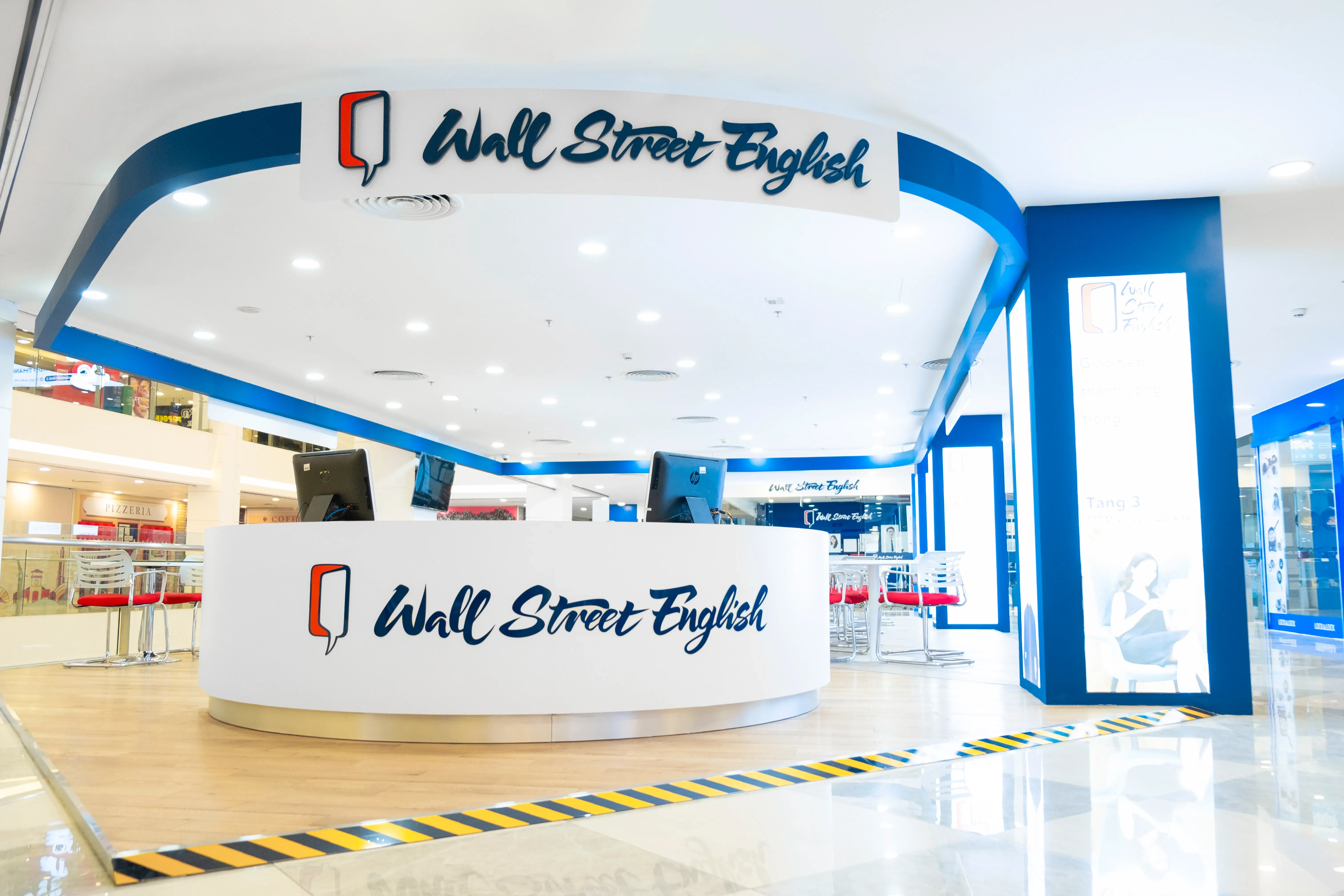
Wall Street English serves busy professionals seeking flexible, high-support English learning through a premium model.
To win in a crowded market with well established brands (VUS, ILA, Apollo English, and others), we needed to innovate at the product level but also to build a much more efficient operating ‘machine’.
This required visibility through the entire funnel (from marketing and telemarketing to sales consultations, enrollment, student progress and upsell/renewal) so we could tweak our 'machine' based on data, in real time and measure results in a consistent manner.
The challenge
There is no ‘Wall Street English Operating System’.
Before building the Vietnam operation, we visited and studied several Wall Street English businesses across Southeast Asia.
Most relied on a collection of specialized systems from different vendors, manual processes and integrations.
The typical rationale was ‘We’re not a software company, therefore we externalize software capabilities to vendors’. While this had some appeal, it created the illusion of staying focused , but in fact didn't provide real-time and granular-enough insights really fine-tune business operations.
That created unnecessary in-fighting between sales (where are my leads?), marketing (sales need better training to convert leads!) and student success (students were overpromised!).
01
Too many system boundaries.
Marketing, telemarketing, center sales, enrollment, student services and learning each generated useful information, but didn't travel across the entire customer journey, cementing silos.
Complicated integration required vendors to intervene, adding costs, time and complexity.
02
A fragmented operating picture.
Management could see activities by silo, but didn't have an integrated performance picture. Between silos, data also sometimes differed, eroding trust in the data itself.
Staff frequently had to reconstruct context manually, slowing things down and introducing more errors.
03
Hard to enforce branch consistency.
With data fragmentation came process fragmentation. Each center started to diverge in small ways, but such changes would compound over time.
This made it harder to scale and stay consistent across brand and service quality.
04
Every improvement created more patchwork.
New acquisition channels, new products, new reporting requirements and new service initiatives all created additional integration requirements.
More time needed to be spent on fixing data and reports instead of focusing on the customer and true operational excellence.
The solution
A bespoke technology backbonefor a bespoke operating model.
Winning in a highly competitive environment meant outcompeting the market on the entire operational spectrum, from customer acquisition to delivery, as well as iterative improvements along the way.
As a member of the founding team and in charge of all-things Technology, I decided to build a custom platform from Day 1.
Four principles shaped how we actually built it.
01. Built to change
Frequent operational tweaks meant adopting an agile approach.
As a CIO, I prioritized the roadmap around the needs of the first center launch, and across all functions of the organization, from Marketing to Telemarketing, in-center sales and student operations .
After launch, we released upgrades weekly and urgent patches daily. This agile approach allowed everyone to work with the full functionality required to operate, while leaving enough bandwidth for the tech team to work on the next big operational improvements.
We also avoided designing around rigid workflows or forking existing open-source codebase to retrofit our operations into generic systems.
Instead, we started with the exact needs at the operational level and built from there.
02. Forward-deploying engineers
Engineers were immersedin operations to build the right things.
The traditional software development cycle typically start with a business analyst documenting requirements, passing these on to devs who code, who then pass that on to QAs for testing.
In our case, it would have taken too long. We opted for forward-deploying engineers directly into operations, well before the model became hype (we started in 2013).
Engineers spent time inside the centers, shadowing frontline staff, observing customer flows and front-line staff challenges, and co-decided on the most impactful changes.
This removed much of the translation between the people experiencing a problem and the people building the solution. This also meant fronline staff were directly involved in the development process.
When both engineers and front-line staff worked together, they could identify and address issues way faster than management could, leading to more effective and efficient workflows deployed in real-world operation.
03. Staying in-sync at all times
Fighting scope creep and change fatigue.
A fast build-and-release cadence creates its own risks. Every team has requests, every operational problem can look urgent, and too much change can overwhelm teams.
One of my main role as CIO was to kept all stakeholders in sync, from Executives to front-line staff, and explaining trade-offs based on business priorities, not personal preferences.
Requests were indeed not treated equally. We looked at their effect on sales, student experience, operating efficiency and the ability to scale before deciding what should be built next.
That discipline helped us resist scope creep while still reacting quickly when a genuine operating constraint emerged.
Thanks to clear and transparent communication, a high-paced release cadence and careful change management, we were able to maintain momentum without overwhelming teams.
04. Make operations co-own the change agenda
Involving front-line staff in every build and their own training.
Thanks to our agile release approach combined with the forward-deployed model, front-line staff were able to provide valuable insights and feedback on what was needed to keep winning.
Local leaders emerged and were trained to become champions of the new digitized processes, training their team members as a result.
Together with designing incentive schemes that rewarded continuous improvement on certain business metrics, we not only ensured technology was delivered but that it was also eagerly adopted by all.
This approach allowed us to scale quickly, stay efficient and maintain quality across more than 20,000 students.
The business outcome
Scaling fast and taking market leadership.
When PE firms approached us for an acquisition, their independent research showed that we had gone from 0 to 40% market share in the adult segment in ~4 years.
The combination of high-quality people x a differentiated product x a built-for-purpose tech backbone was crucial to our success.
20,000+ students, 6 centers, 4 years
Centers operated on a shared system, shared processes and shared management model from Day 1, enabling fast growth.
By combining a product designed specifically around the needs of busy adults (and not kids) and superior technology, we were able to deliver quality, at scale, and in a preditable manner.
Leading student experience and course completion
Thanks to granular insights about every single student and highly trained student success teams, we achieved the highest student NPS scores and course-completion rates across Wall Street English's 27 operating countries.
This translated directly into more positive word-of-mouth, referrals, renewals and eventually the ability to add on more products to upsell.
Premium economics
The company maintained its premium positioning while continuing to increase prices as the business developed.
Operational visibility made it possible to manage growth without losing sight of service quality or economics, supporting healthy EBITDA margins alongside expansion.
Market leadership and successful exit
Within 4 years, Wall Street English Vietnam went from 0 to 40% market share in the adult segment.
The business was subsequently acquired by a private-equity investor.
Our bespoke Operating System enabled the commercial model, service model and operating model to work together as one and win in a crowded market.
The Operating System
Multiple centers and offerings, but one single platform.
Everyone thinks they need a better CRM. The reality is that to win, you need a comprehensive, bespoke Operating System that integrates all key aspects of the business.
That's what we built.
Technology became a core competency and an integral part of our competitive advantage.
Unlike most competitors at that time (we started in 2013), we treated technology as a strategic competency from Day 1.
There were a few other factors in our success, such as people, processes and a differentiated positioning. But Technology was the glue that made all of it hard to replicate, and eventually enable us to win in a highly competitive market.
There is definitely some truth to the saying that ‘Every company is a Technology company’.