
RegenX · Climate tech · 0 → 1 · AI in AgriTech
Turning regenerative farming into measurable carbon reductions.
We built a farm-level intervention and data model that helped coffee farmers reduce their dependence on synthetic fertilizer while giving global buyers a more credible way to measure carbon reductions inside their own supply chains.
$500K
VC funding raised
120+
Farmers in initial pilot
70%
Farmer app adoption within 60 days
Farm-level
Carbon data captured through the pilot
The situation
The hardest part of agricultural decarbonization happens at the farm gate.
Large agri-food companies have committed to reducing their carbon emissions.
But a significant part of those emissions originates at farm level, through practices such as fertilizer use.
A buyer can set a carbon target at headquarters, but achieving it requires thousands of independent farmers to change how they operate, and provide further evidence that a carbon impact has been achieved.
Without granular farm-level information, this proved to be impossible.
The challenge
The companies accountable for Scope 3 emissions do not control the farms producing them.
Agricultural supply chains are complex, involving exporters, collectors, cooperatives, processors and other intermediaries between global buyers and farmers.
Each participant captures the information required for its own transaction but have few incentive to collect detailed agronomic data and transmit it downstream.
Recognizing that decarbonizing the supply chain was essentially an incentive and behaviorial change problem, I raised $500K to attempt to solve that problem.
01
The data disappeared between intermediaries.
Buyers might know how much coffee they purchased and where a shipment originated, but rarely had sufficiently granular information about individual farming practices.
Every additional intermediary made farm-level visibility harder.
02
Measurement alone would not reduce emissions.
Many better carbon calculators exist but they only calculate theoretical numbers.
To get real change required working with farmers to change their fertilizer practice in the first place.
Any viable solution therefore had to combine farmer interventions with data collection.
03
Farmers needed an economic reason to change.
Farmers optimize for yield, risk and income, not corporate carbon targets.
Regenerative practices therefore had to make sense at farm level: lowering dependence on expensive synthetic inputs without sacrificing yield.
Therefore, the farmer programs had to be designed with their economic incentives in mind.
04
Carbon reductions had to connect back to actual purchases.
For buyers, aggregate sustainability statistics were not enough.
The goal was to establish credible farm-level evidence that could eventually connect changes in farming practice to the coffee being purchased from that supply chain.
That meant building both an intervention model and a data model.
The solution
We built the intervention first, and made carbon data a by-product of changing farming practices.
We deliberately started with coffee: one of Vietnam's largest and most internationally visible agricultural supply chains.
Rather than trying to sell standalone carbon-accounting software, RegenX partnered with exporters and global buyers around farmer-transition programs.
The model combined on-the-ground agronomic intervention with technology, AI-assisted advice and structured farm-level data capture.
01. Start with farmer economics
Decarbonization had to improve the farm economics, not just the carbon report.
The first objective was to help farmers reduce dependence on synthetic fertilizer without reducing yield.
Programs introduced regenerative practices such as composting and alternative nutrient-management techniques alongside existing farming methods.
This changed the proposition from asking farmers to provide sustainability data to helping them reduce input dependency and improve how they farm.
02. Combine software with people in the field
This could not be solved through an app alone.
Agricultural practices are physical, local and highly contextual.
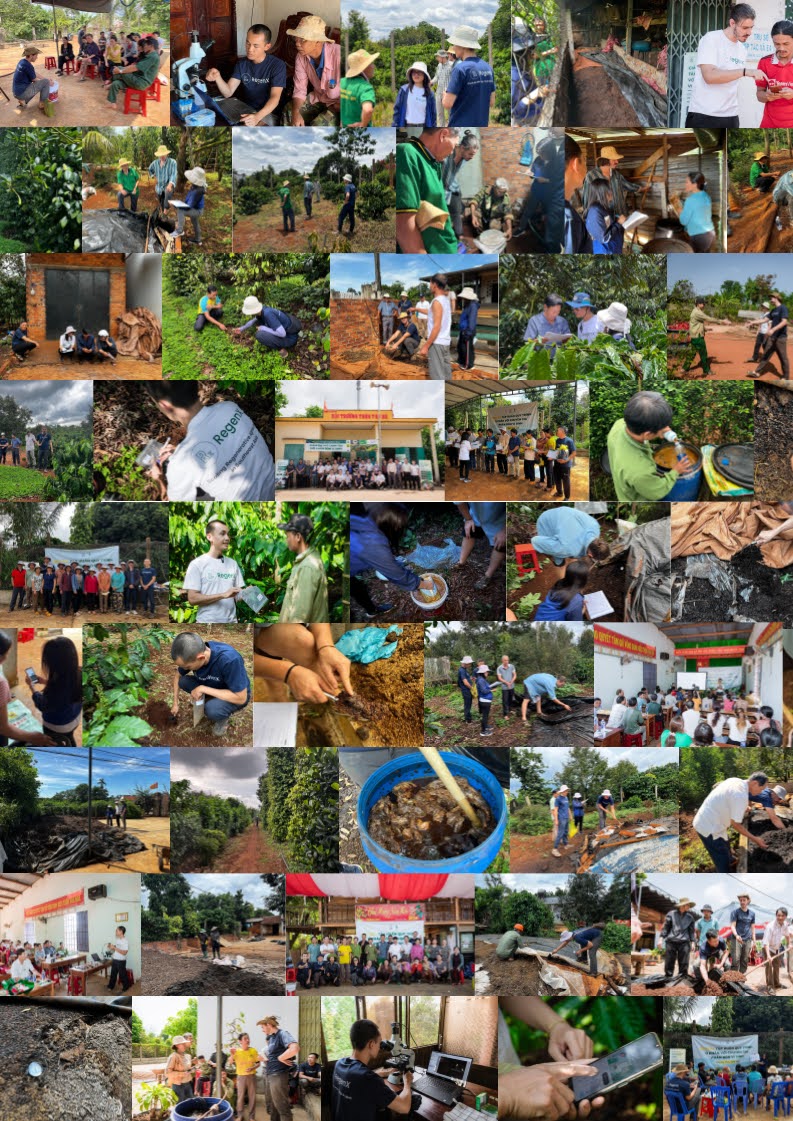
We therefore combined digital tools with offline farmer programs and field intervention.
Agronomists and field teams worked directly with farmers, while the technology layer extended their reach between physical interactions.
The operating model was deliberately hybrid: people changed behavior; technology helped scale and measure impact.
03. Use AI to make agronomic support more scalable
Personalized recommendations turned farm data into something useful to farmers.
Farm-level information was used to provide more personalized agronomic guidance instead of generic recommendations.
AI helped make this advisory layer more scalable, while simple mechanisms such as fertilizer-use disclosure and photo-based capture reduced the burden of collecting information from the field.
That created a flywheel: farmers received useful agronomic advice, RegenX received better data, and using the right farming pracitce improved farmers' economics and reduced carbon emissions.
04. Capture the evidence needed by the buyer
Every farmer interaction strengthened the carbon data layer.
Instead of running a separate carbon-data collection exercise, we incorporated evidence gathering into the farmer program itself.
Changes in fertilizer use and agricultural practice were captured at farm level while agronomic advice was provided.
This created the foundation for something more useful to buyers than another sustainability dashboard: a traceable link between intervention, behavioral change and carbon reduction.
The business outcome
We proved that farmers would change and that buyers were willing to engage around the resulting data.
120+ farmers in the initial pilot
We deployed the model with more than 120 coffee farmers and began transitioning participating farms toward practices designed to reduce dependence on synthetic fertilizer.
This provided a real-world environment to test the intervention model rather than validating the concept through software usage alone.
70% farmer app adoption within 60 days
Despite being notoriously hard to digitize, 70% of participating farmers began using the application within the first 60 days.
The digital product worked because it was attached to a tangible farming program rather than offered as a standalone technology.
Commercial partnership with a major Vietnamese coffee exporter
We established a commercial partnership with one of Vietnam's largest state-owned coffee exporters, giving RegenX access to an existing agricultural supply chain rather than attempting to construct one from scratch.
That partnership was central to the model: distribution came through organizations already trusted by farmers and already connected to international buyers.
Buyer interest beyond the pilot
The resulting farm-level data generated interest from multinational coffee buyers and traders exploring how the model could be deployed inside their own supply chains.
Discussions progressed beyond sustainability reporting toward whether farm-level reductions could become part of the commercial relationship between farmer, exporter and buyer.
From carbon offsets to carbon insets
We co-designed a model with industry participants for connecting verified farm-level reductions directly to the coffee being purchased.
Instead of compensating for emissions by buying unrelated external offsets, buyers could potentially inset reductions inside their own supply chains.
That moved RegenX from being an agronomy application toward becoming infrastructure for agricultural decarbonization.
The impact model
One continuous loop, from farmer economics to buyer carbon reductions .
The technology only worked because it connected the incentives of farmers, field teams, exporters and global buyers in one operating model.
AI was useful because it produced value in the real world.
AI made personalized agronomic support and farm-level data collection more practical.
But the real impact came from combining technology with behavior change, working side-by-side with farmers on their economics and convincing international buyers to adopt a new approach to buying ingredients.