Before digging into the actual history record, let me start with a personal anecdote
In my early 20s, I was working in Paris at Crédit Agricole (a huge bank), and was tasked to lead part of an enterprise-wide technology transformation.
European regulators were forcing banks to migrate from an old standard of communication (basically plain text files) towards XML 1, as to allow cheaper and automated transfer of banking information across the heterogeneous banking network in Europe.
As a naive engineer, I just thought “Well of course, using plain text for this is actually quite dumb”. But banking and interbank transfers were invented a long long time ago, well before XML.
My boss took me on a tour of the bank’s large back-office operations, outside of Paris, to explain why the change was necessary, what the transformation roadmap was like while at the same time map the existing processes onto new workflows.
I remember spending a whole afternoon sitting next to 50-something-year-old operators, shadowing them doing their jobs.
When an interbank file was rejected, they had to figure out what was wrong with it, and either fix it or escalate the problem. Part of the job literally involved counting spaces and characters to find anomalies.
For example, if Field 2 was supposed to have 8 characters and prefixed by 0 (eg 00001234 and not 1234), but was missing a 0, the file would bounce. The fix was to just add the missing character.
This sounds totally arcane today, but that’s how the European banking system used to work (I wouldn’t be surprised if parts of it still work that way today).
During our visit, I did the usual process and role mapping, workflow documentation, workflow automation designs, etc.
I told him what I was trained to say: “Well, there will still be a lot of monitoring and transition work to do during the transformation. The company also has a career transition plan and will communicate the details shortly.”
A delicate conversation indeed, especially when people have spent their life working at the bank, and felt now “disrupted”.
Within a year, the transformation was in full swing. We redesigned old processes, people were reskilled while others took the early retirement options. We became the first bank to launch some new banking services based on the new interbank standard, and I was eventually asked to share some of what we had learned with other European banks.
Today, it is the software engineers who are in that awkward spot, along with BPO operators, customer service teams and a few others.
AI pundits say that there will be new jobs created and that demand will explode.
But does the historical record agree?
The mechanization of textile: job destruction and creation, all at once
The textile industry was huge for Britain during colonial times. Its mechanization happened in the early 1800s and shows a gradual displacement of jobs within the same industry.
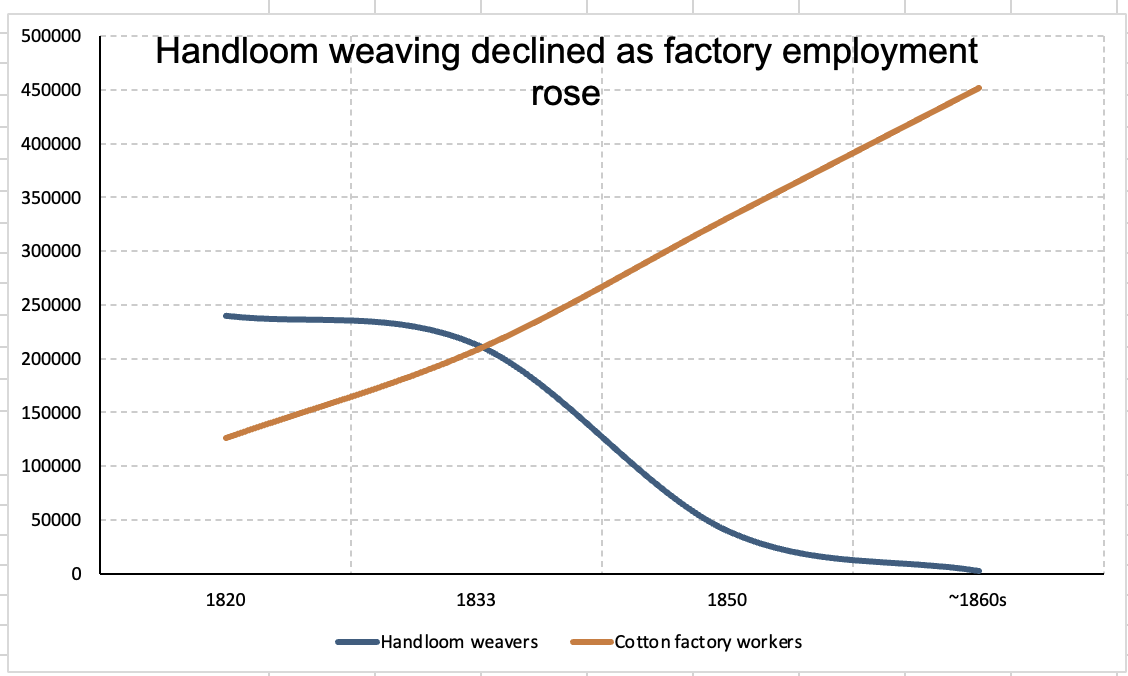
In 1820, according to historical records, there were 240,000 handloom weavers (people manually making fabric out of threads) and 126,000 cotton factory workers (a majority spinning fibers into yarn and a minority weaving yarn into fabric).
13 years later (1833), despite progressive mechanization of the loomweaving job, there were still 213,000 handloom weavers (a decrease of ~11%, or ~1% p.a. over the period)
Meanwhile, there were 208,000 factory workers (an increase of 65% in the same 13 years, or ~ 4% p.a.).
So in that period, factories created more jobs. Then things started to accelerate.
By 1850 (a full 30 years after our starting point), there were 40,000 handloom weavers left, against 331,000 factory workers (an 83% decrease and 163% increase, respectively). The equivalent increase in factory workers would only be 3.3% CAGR, so one would barely notice it from a year to another.
By the turn of the 1860s, 40 years after the fact, only 3,000 handloom weavers were left, versus 452,000 factory workers.
By the numbers, one can say that:
- Mechanization definitely destroyed jobs and created many more jobs in factories
- Disruption feels like “slowly and slowly, then suddenly”. It took a few decades for factory work to dwarf handloom weaving
- Whether the person who lost one’s job was the one working in a factory is not clear. There were surely a lot of people who were like my former banking colleague
In the end, this first industrial revolution made producing textile much cheaper.
The population was also growing, export to colonies made for a captive market, the economy boomed and people just bought more cheap clothes.
That is a poster child summary of “with technology, we make more things that cost less per unit, therefore people will keep buying more”.
But we’ll get back to that in a minute. After talking about clothes, let’s talk about food.
The mechanization of agriculture: more food, less farmers
The mechanization of agriculture is somehow similar to textile. Instead of mechanized looming and weaving, you had tractors.
In the early 1900s, in the US alone, ~11 million farmers produced food for 76 million people. Around the 1910s, they adopted tractors, which evolved into machines able to plow, pick corn, harvest, etc. Basically, to do everything they used to do, but faster and cheaper per unit of harvest.
By the 1930s, the farmer workforce was still around 10.5 million farmers, using ~920 K tractors. By the end of WWII (1945), tractors reached ~ 2.5 million, and 3.6 million only 5 years later (1950).
Comparatively, farm labor went from 10.5 million (1930s) to about 7 million (1950s), a 33% decline in farmers vs 290% increase in tractors. Just like with textile production, food production cost decreased. The % of the workforce working in agriculture kept declining, from 37% in the early 1900 to 11% in the 1950s. Today, it stands at a low 1.5% in the US.
Where did all these people go?
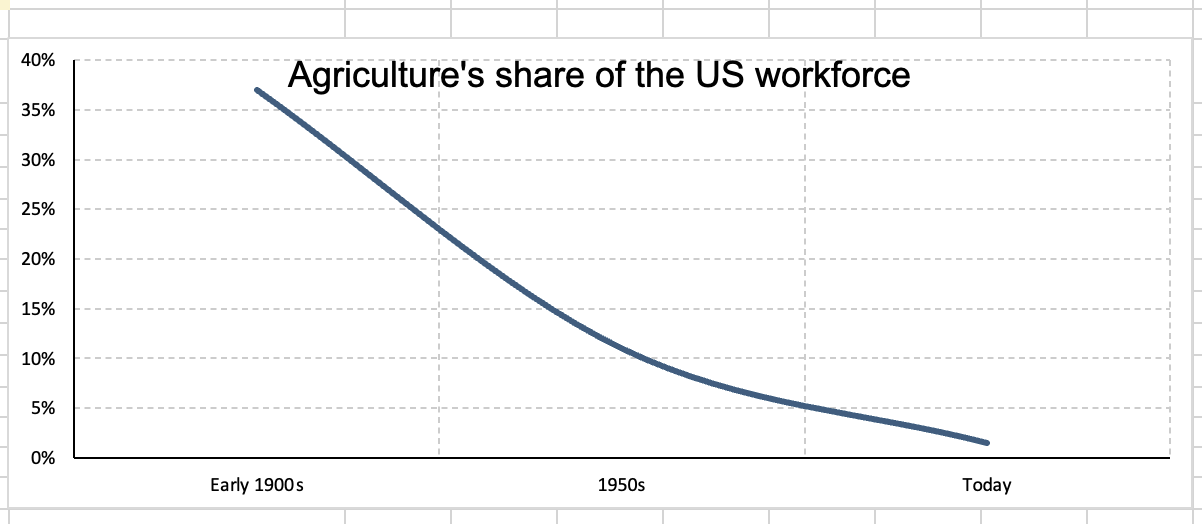
We don’t really know, at least not at the individual level. We just know that non-farm employment increased at the same time, and urbanization and industries needed more workers than ever.
At the same time, electricity was spreading everywhere, and it changed almost everything.
Electricity: the classic GPT (General Purpose Technology)
GPT (the one from OpenAI) stands for Generative Pretrained Transformer, not “General Purpose Technology”. Although I don’t know if they chose the acronym on purpose.
Electricity is probably the historical analogy to AI you’ll hear the most, because they enable other things rather than being the thing itself (one can buy food and clothes, but what’s the point of buying “electricity” if it doesn’t power something else?).
Here’s how that went.
Around 1900, only about 5% of US factory power was applied through electric motors. Most were still using steam as the main power source, where a central steam engine powered a host of machinery around the factory.
Electric motors are much smaller and therefore can accommodate smaller machines, without compromising on output (compared to a steam machine).
But it took some investments in redesigning factory floors to accommodate for that. Plugging electricity in a steam-powered machine worked too, but you didn’t capture much of the potential increase in total outputs.
Because of that, electric motors adoption was quite slow.
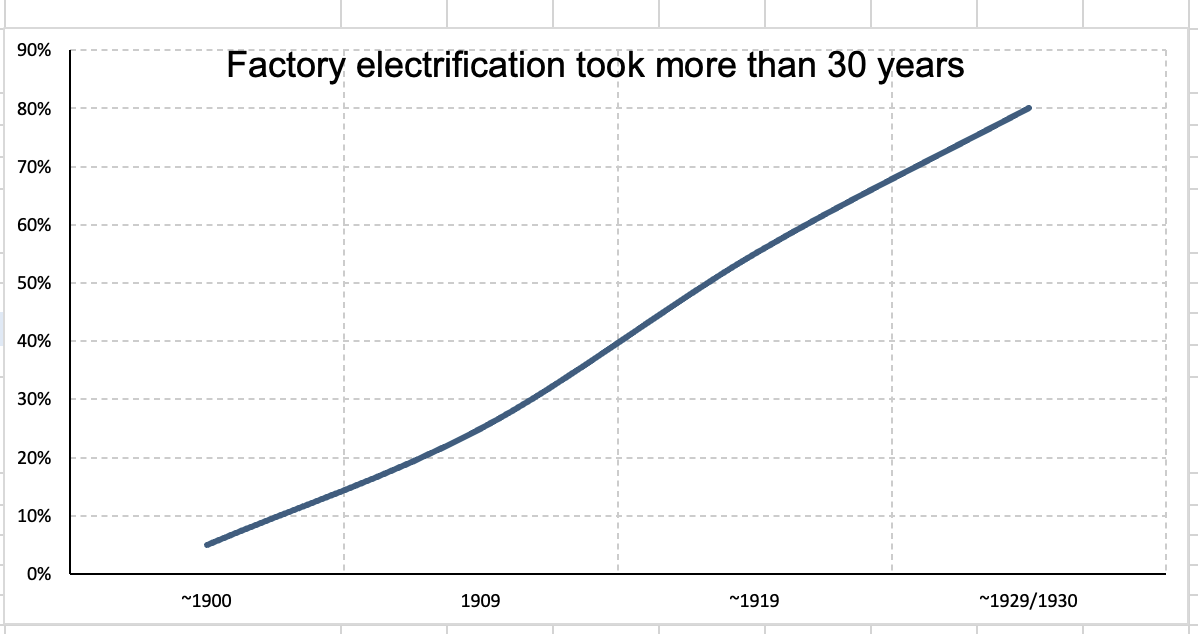
By 1909, they were 25% of US total factory power. 10 years later, they were 55%. Another 10 years later (now in the 1930s), they represented about 80%.
So even with something as powerful as electricity (can you imagine an entire day without electricity at all?), it took a whopping 30 years for factories to adopt what looks on paper like a “Duh, of course you should electrify” decision.
As for job disruption, electricity surely disrupted people who sold steam engines. But the totality of what was made possible, from mass production of stuff to powering every home in America, probably dwarfed the number of jobs destroyed.
That sounds like the AI dream land. It will power every one of us with “a thousand geniuses in our pocket”.
To do what exactly? Well…we don’t know yet. It surely helps me with any digital task or random question I have. But the added value doesn’t feel anywhere near “I have electricity” vs “I don’t have electricity”.
Another technological shift changed the urban fabric of the US and the world: the car.
The car revolution: creating new jobs in unrelated industries
The automobile clearly destroyed jobs around horses: carriage making, stables, horse transport, horse feed, etc.
At the same time, it took a lot of people to build cars. The story of textile in colonial Britain and US agriculture in the early 20th century repeated themselves.
US automobile manufacturing employed only about 2,500 people in 1899. Ford launched the Model T about 10 years later (1908). By 1919, the industry employed 394,000 people (making 2 million cars per year). That’s a 157x jump in employment in 20 years (!), or roughly 29% CAGR.
Surely, horse-related workers could work in auto factories. But the bigger change was not even that.
Once ordinary people could travel more and for lesser and lesser money, America started reorganizing itself around the car. It gave birth to petrol stations, garages, roads, tyres, dealerships, motels, trucking and eventually huge amounts of suburban construction.
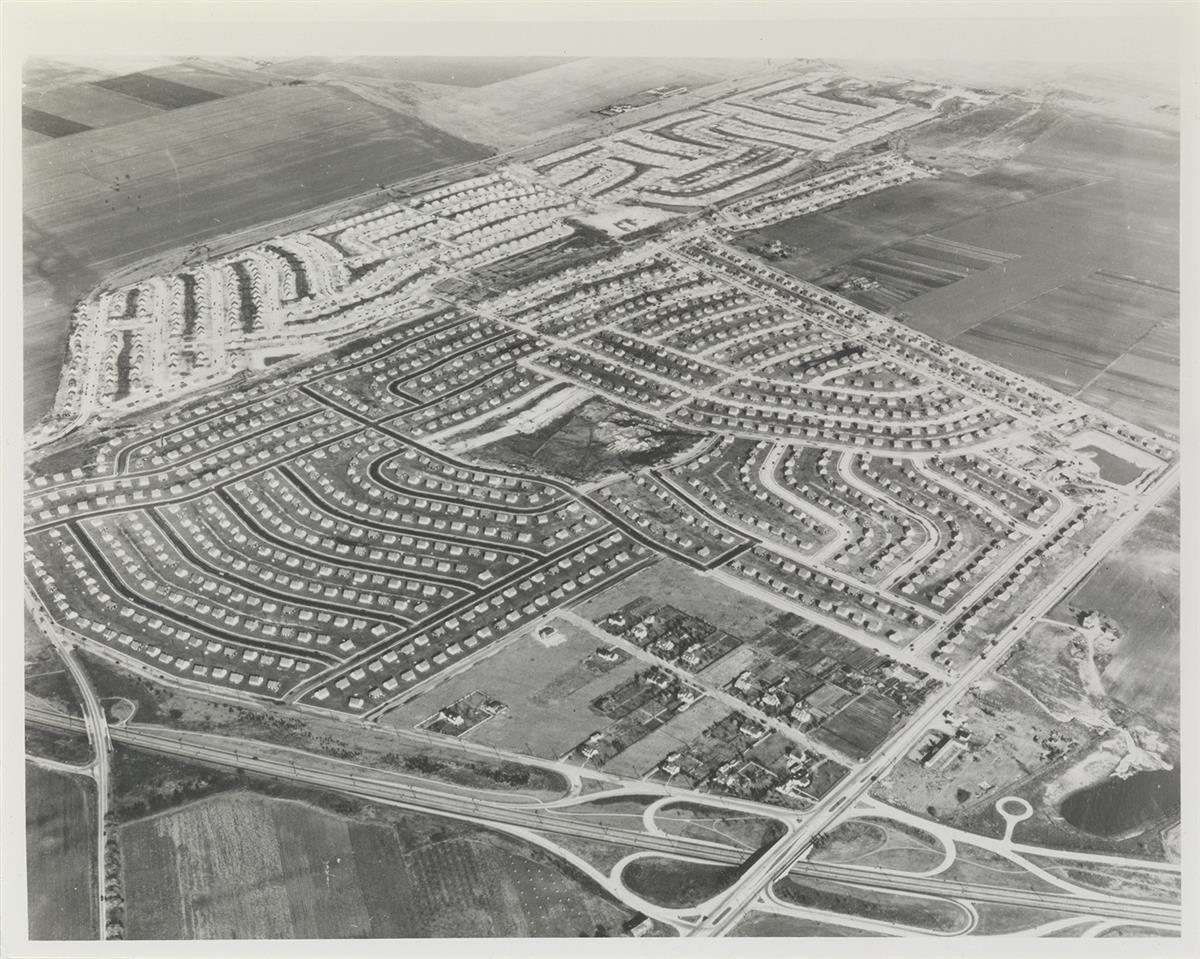
So the car borrowed some lessons from textile and agriculture, and added the second-effect of electricity: it made other industries possible.
Towards the 1990s, the internet came along. As Peter Thiel famously said, after all these technological revolutions, we thought we were going to get a flying car! Instead, we got 140 characters.
But not everything about the Internet was that disappointing.
The Internet: enabling global commerce (and a bit more)
The Internet made moving information dirt cheap.
Suddenly, one could exchange data and transact across the globe, for almost free.
That enabled SaaS, global e-commerce, online advertising, digital marketplaces and plenty of other categories that didn’t even exist.
When I was still in university, PHP was all the craze. I got involved in building and indexing affiliate websites, where someone, somewhere, would search for something, land on one of my websites, click a link, buy a product from somebody I had never met, and I would get a commission.
That kind of thing was pretty new.
The strange part is that the Internet enabled new intermediation businesses, while disrupting traditional intermediaries.
US newspaper publishing employment, for example, fell from almost 458,000 in 1990 to about 183,000 in 2016, while employment in Internet publishing and broadcasting increased from about 30,000 to almost 198,000 over roughly the same period.
Travel agents and classified ads suffered a similar fate.
But as with the electricity, while the technology itself was intangible, the second-order effect (and jobs created) were very tangible.
Its impact was amplified big times by the next revolution: the mobile phone.
The mobile phone: somewhere between clothes and the internet?
Just like clothes, you can buy more phones. And like the Internet, smartphones created new categories (ride-hailing, food delivery, many forms of mobile banking, the app ecosystem, etc.). It even replaced its own “1000-songs-in-your-pocket”.
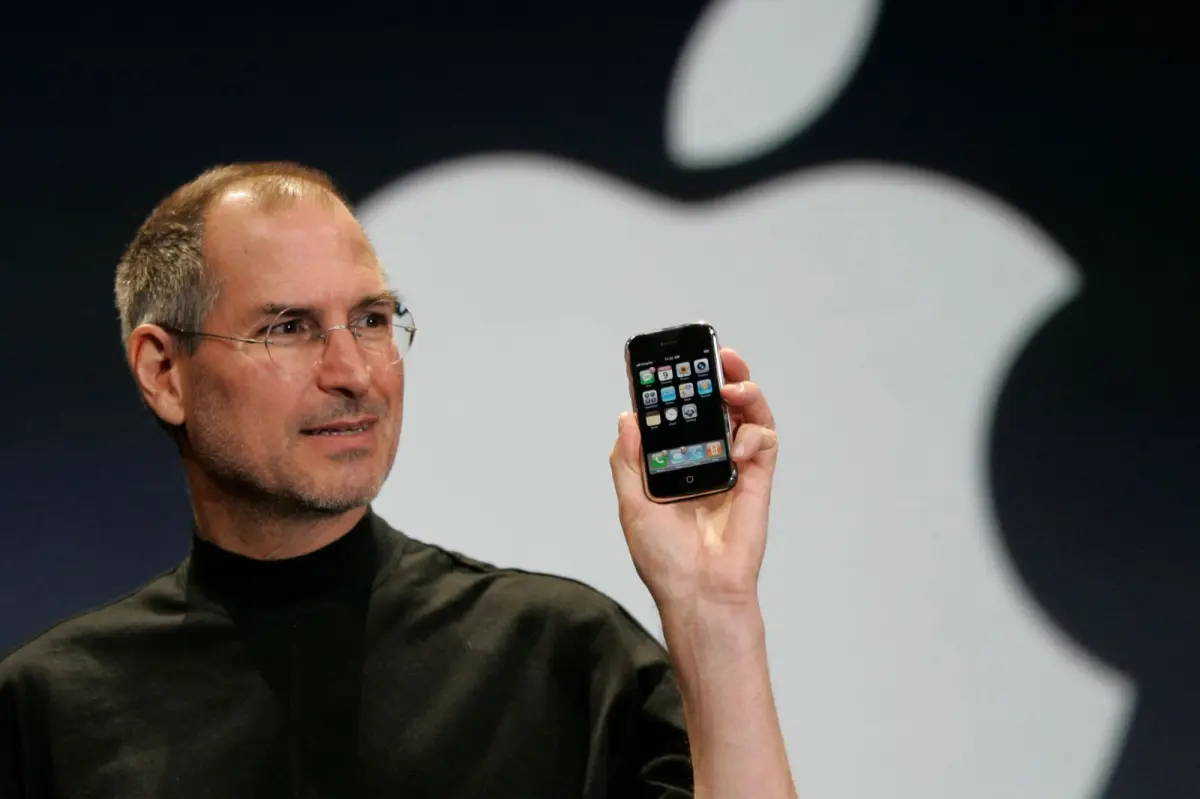
But what was its impact on jobs?
That’s not very clear cut, but we do have some statistics around it.
- GSMA estimates the mobile ecosystem supported about 40 million jobs in 2024, of which 24 million were directly in the ecosystem and 16 million were indirect.
- Another report by the Progressive Policy Institute says jobs related to “the App Economy” was basically zero before the app store (2008) and jumped to 2.5 million jobs by 2022 in the US alone.
- Thanks to ride-hailing, millions of non-taxi drivers took on driving and were “employed by an app”
So without being a General Purpose Technology, the mobile still enabled lots of new categories, and extended the power of being “always-on” brought to us by the Internet.
Will AI extend digital addiction brought to us by the smartphone?
It is not clear yet, and that’s a totally different topic.
For now, let’s wrap up and circle back to the original question.
So what does History really tell us about “Will AI create or destroy more jobs?”
The textile and car revolutions created jobs in the same industries, while the mechanization of agriculture put farmers out of farming, but into jobs needed elsewhere due to fast urbanization / industrialization.
Electricity enabled totally new things to be done. The car triggered suburban development. The internet created new online business models, on which mobile piggy backed on.
All displaced jobs in incumbent industries.
The pace and diffusion of each new technology always took decades, not just a few years. It varied based on the demographic and economic conditions of the time, including regulations, risk appetite, etc.
Hence, History’s conclusion on AI is as follows.
Same in the fact that it is sure to displace and create some jobs and perhaps categories. Different in the pace of diffusion and use cases.
If we put AI in the context of our current demographic / economic / geopolitical conditions, we may have a better chance at guesstimating the future.
Some of the relevant macro trends include, as of Sep 2026:
- Decoupling of economies (especially from China) trending towards more national resilience and near-shoring and re-industrialization (at least in political discourse)
- 2 ongoing international wars (Russia/Ukraine, US/Iran) putting strains on energy prices and availability
- Aging Europe, aging China, aging Japan, demographically stable US, while a large share of newborn will be concentrated in Africa
- Rise of right-wing parties across western Europe, on a backdrop of high public debt, higher cost of living and mounting discontent about immigration
- Clear willingness from the US to throw its weight around as to make “America first”
- AI dominance at the frontier by the US, with China dominating AI open weight models
- Tight AI regulations in EU, looser ones in the US and overall promotion of AI in China
- Severe predicted shortages of electricity-related infrastructure due to AI datacenters
- Rise of autonomous or coordinated AI cyber attacks, which predictably lead to attacks on critical infrastructure and cybercrime
If I squint, the pattern may be as follows.
- Reindustrialization in developed countries where labor cost is high + aging population = rise of AI-powered robots in the developed world.
- Will China supply the bulk of them, defeating the efforts of decoupling, or will Optimus make America great again?
- Power resilience invariably means more appetite for nuclear, SMR 2, and also anything power-related from solar to wind to more exotic sources of power
- Datacenter ongoing investment and construction takes specialized labor. It may not continue forever, but as urbanization in the US during the car revolution, it will certainly create job opportunities
- Militarization of AI, especially in the US, China, Europe, Japan
- AI cybersecurity becoming not only a key national defence capability, but will probably become big industry of its own
- Finding better / more ways to make AI output trustworthy may become one of the biggest challenge of this technological revolution
- Need for actual people to care for elderly, basically everywhere (minus Africa, for now). Robots may help on trivial things, but there’s really nothing like the human touch
- Will we be fed up with AI and want more physical, human-first entertainment, creating new outdoor jobs? Maybe.
For Southeast Asia in particular, it’s a mixed bag. Some of the relevant macro conditions include:
- Vietnam benefiting from China + 1, although a lot of the investments are just from Chinese firms bringing their capabilities to Vietnam to avoid tariffs
- Strong headwinds against cognitive outsourcing (software in Vietnam, BPO outsourcing in the Philippines)
- Singapore and Malaysia becoming the regional hubs for AI inference (datacenters)
- Indonesia still the champion in mining, palm oil, nickel and other raw exports
- All (except Singapore + Brunei) being stuck in the middle income trap, albeit at various ends of the spectrum (Vietnam on the lower end, Malaysia on the higher end)
- Intensifying military presence of China in the East Sea
- Aging region overall, but where labor is still relatively cheap and abundant
In SEA, “rent” in inference datacenters in Singapore and Malaysia is pretty concentrated at this point, and will likely remain so.
Surely, there will be other spillover effects from AI (some companies “agentifying” means implementation opportunities, etc.), which are good things for certain individuals, but not that big of a deal at the macro level. I may be totally wrong on that.
And just like more developed countries, healthcare has good tailwinds given the region’s demographics.
The impact of AI is really going to be uneven, it seems. As for a flying car, well, we will have to keep waiting.
Sorry, Peter.

Further reading
- Learning from Ricardo and Thompson: Machinery and Labor in the Early Industrial Revolution
- The 20th Century Transformation of U.S. Agriculture and Farm Policy
- Employment Outlook in the Automobile Industry, Bulletin No. 1138
- Employment trends in newspaper publishing and other media, 1990–2016
- The Mobile Economy 2025
- World Population Prospects 2024
- Energy and AI