A summary of outsourcing M&A in Vietnam in the last 10 years
Activity in M&A is always a good signal to track how “hot” the industry is. The data that I have shows that the Vietnam software industry is well past its golden age.
Some disclaimer first: I spent time scrapping and analyzing this data based on publicly available information and using AI. Since not all deals were publicly announced, it is inevitably incomplete.
Also, lots didn’t have data on how much the buyers paid. So I will stick to deal counts as a proxy for activity.
Here’s what the analysis shows:
- I found 35 M&A publicly documented transactions in the software outsourcing space since 2015 in Vietnam.
- Japan bought a whopping 70% of all deals!
- Peak M&A time (eg with deal count above the average of 3.5 / year) was 2018 and 2019 with 11 deals (about ⅓ of the total deals of the last 10 years) as well as 2023-4 with 9 deals (25% of the total of the L10Y)
- 2026 saw a single transaction and I was generous to include it despite it being essentially a parent group buying its own subsidiary
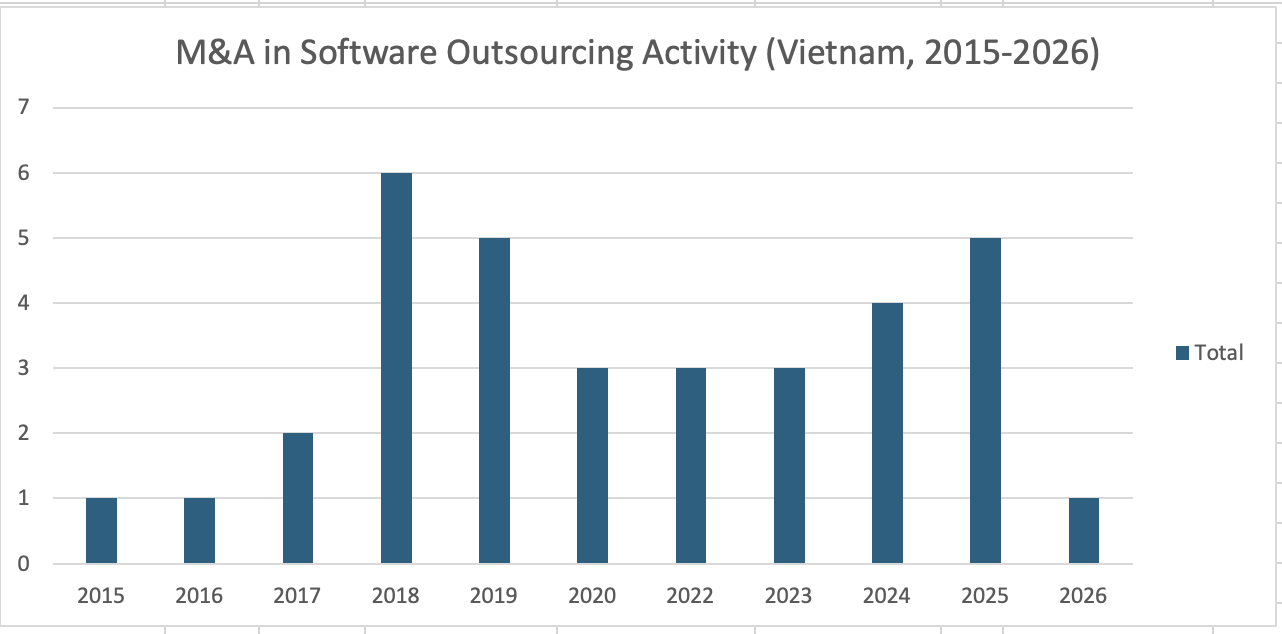
Anecdotally, casual conversations with friends in M&A also point in the same direction: there’s just not much happening in outsourcing this year, and multiples offered are way lower than what they used to be (some companies traded at 12-15x EBITDA c. 2023-4. In 2026 you’d be lucky to get even a 7-8x).
This can be seen in hiring and salary trends too.
Being an operator in the tech industry in Vietnam, I naturally track these, and they are definitely down. It was not unusual to pay 2,500-3,000 USD salaries for Full Stack Engineers or Mobile Engineers, depending on seniority. They were the most sought after engineers.
Fast forward 8 years later: these labels have aged badly and one would be hard-pressed to get that type of salary. The AI Engineer is the new Full Stack Engineer, and even then salaries have adjusted down given the lack of actual AI experience (which is normal given how early we are in the AI wave).
It is a hard reckoning for Vietnamese engineers and outsourcing business owners. Similar trends are happening in India.
Bearish trends in the global epicenter of outsourcing: India
India’s IT-services industry generates roughly $315 billion a year, of which software outsourcing is ~ 250 $B. It is huge (about 50% of the entire Vietnam GDP). Lots of the Fortune 500 companies have outsourcing partners or captive GCCs in India (Global Capability Centers). The US takes up about half of all outsourcing services produced there.
But AI has been shaking up the industry quite a bit: as of Aug 2026, the Nifty IT index fell by 20%, erasing ~ $70 billion in market value. Why? Here’s what the biggest industry players are saying.
- “Clients were demanding the same work for 25% to 30% less while expecting faster delivery and higher productivity.” - Sandeep Kalra, CEO of Persistent Systems
- Roughly 80% of its finance, HR and other business-services contracts are now outcome-based." - K. Krithivasan, CEO of Tata Consultancy Services (TCS)
- Some rivals are factoring in productivity gains of 70% to 80% over five to seven years and guaranteeing prices despite rising chip costs… Clearly, there is a ton of competition out there, and our competition at times is doing irrational things." - Mohit Joshi, CEO of Tech Mahindra
Of course, with such an exposure to the fastest moving market in the world when it comes to AI (US), one would expect that India gets hammered.
Vietnam has a much smaller outsourcing industry (about ~7 $B / year only, or less than 3% of India) and a smaller exposure to the US (about 25%). However, the trend is quite the same.
Taking FPT numbers (one of the big boys in the industry), its stock fell by 25% in 2026 Q1 alone. Foreign investors have essentially exited their position as a way to price in the new reality and risks brought by AI.
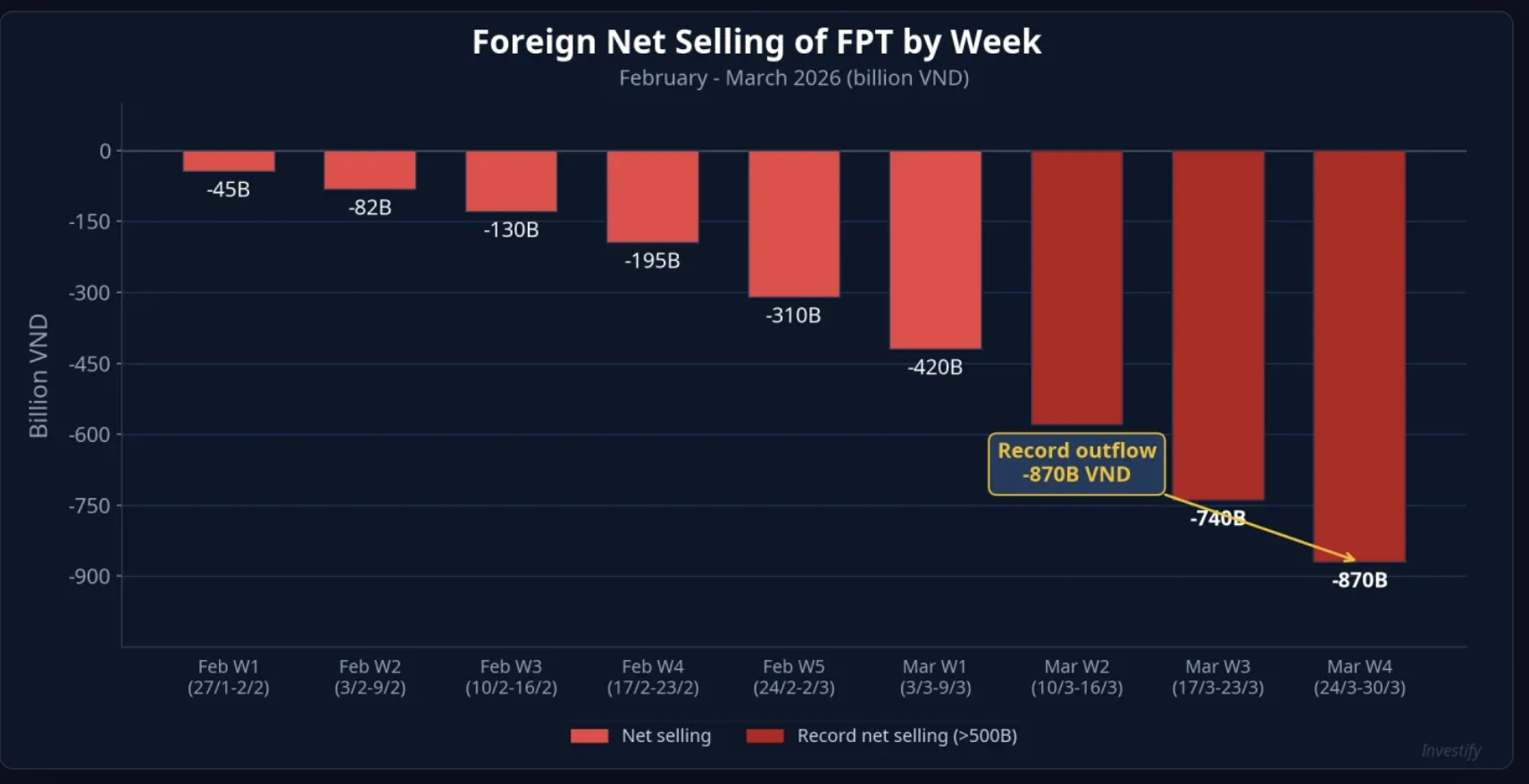
FPT leadership was quick to tell the press and investors that it is making efforts in adjusting its business model, with a target of getting as much as ⅓ of its revenue from AI-driven sources (!).
Japan is still where ~ 40% of their clients are, which makes an uneasy concentration. Surely, they won’t in-shore and build AI by themselves like the US do (they just don’t have enough people, let alone qualified engineers to do the work), so FPT may still have a few good years milking that cow.
But not every outsourcing firm is a juggernaut like FPT who can withstand adverse market conditions.
Unfortunately, I think that most outsourcing firms face a very hard fork:
- hope that what they were doing before AI will still work and predictably go out of business,
- drastically cut staff now to extend the runway while servicing existing legacy contracts and finding new AI demand (which doesn’t come easily),
- or call it a day and decide to exit the industry in an orderly fashion.
The sentiment is overall bearish, although there is still a base case and a bull case to be made. Let’s go through them now.
The base case: the buyer owns demand / distribution
A buyer who has existing customers and just needs more engineers for a certain type of work (industry specificity, legacy migration specialist, etc.) may not be under immediate pressure to transform the business.
There are at least two variations of this.
1. The buyer needs to serve existing customers.
This could be a larger outsourcing company acquiring a smaller one. Think of the Alten-VMO deal (Alten is a listed company in France, and bought VMO in 2024). In these cases, the portfolio of clients you bring is not the major consideration in the deal. The ability to deliver work for existing clients is (generally in the APAC region).
2. The buyer owns the companies for which it needs engineering capability
Think of an investment firm who has invested in a large portfolio of companies (commonly referred to as their PortCo) and want to bring more tech support to them. This is definitely trending up in the US among big and mid-sized PE firms, and increasingly lots of the support has to do with AI implementation.
Here, the demand is captive.
As the investor buys more companies, engineering works expand. Unless the fund is large enough (e.g. in the billions and not millions), the size of the engineering team would generally stay quite modest.
Geographic proximity plays an important role here, so as the market matures, investment funds in SEA could potentially go down the route of their US counterparts and acquire technology capabilities.
For now, I wouldn’t hold my breath for this.
Then there is the bull case, for the most ambitious engineering firms who can partner with investors with high-risk appetite: the AI roll up.
The bull case: the AI Roll up
A traditional PE-led roll up is essentially: use debt to acquire a series of adjacent businesses (say, lots of independent dental clinics), professionalize and standardize them as a way to optimize EBITDA margins, and flip them for a nice profit.
The AI roll up borrows that idea.
So my bull case for acquiring an outsourcing company is basically this: could a buyer buy a firm that already has good AI engineering capabilities, and use it to build the underlying AI platform(s) required to drive efficiencies in the more traditional business the same buyer would acquire?
It is quite a complicated thing to pull off and orchestrate - hence being a bull case rather than a base case. In fact, building a native AI engineering team might be easier. A compelling acquisition would need an existing vertical specialization (say, e-commerce, insurance, etc.) that matches the main target companies.
Bending Spoons is not exactly an AI roll up but it shows the direction of travel: it bought Evernote (among many other digital companies) and cut 60-80% of the company cost (mostly engineering), cranked up features using AI-augmented engineering teams and changed its pricing, turning what used to be a zombie company into a more profitable one.
Having honed its modus operandi, it recently acquired Airtable and is doing the same. There is no reason to believe that they will stop there.
Other investors prefer to start from traditional businesses such as accounting, law firms, clinics etc, get VC backing for the tech build out and debt for the company acquisitions. Examples abound (General Catalyst, Crestline).
No matter the structure and format, the commonality is as follows:
There is also an obvious risk in this model. Anthropic and OpenAI are going public soon, and will have a large warchest to go after the most obvious industries (legal, accounting, insurance brokerage, to name a few) and run that exact playbook.
They’ll certainly acquire existing AI roll ups to go fast (like SpaceX who bought Cursor after IPO). Could one build one of their next acquisitions? That’s a long stretch if one intends to build it from Vietnam. At the very least, the customer base and company should be in the US (that’s where the money is and where the big players go first).
The largest enterprise market around this area of the globe is Japan. If one has a strong appetite for that market and specific insights as to how this could work, this may be worth exploring further (not investment advice :))
Bringing it altogether
The old investment thesis of software outsourcing seems to progressively come to an end for Vietnam.
Big corporations (FPT, CMC, etc.) will probably stick around. Some smaller firms will make it through. For most, it’ll be tough. Some of my M&A friends are waiting for consolidation, but I’m not convinced.
On the other side of the table, some buyers may find good deals, I suspect mostly for strategic reasons than just “add more engineers quickly and cheaply”. However, Technical Due Diligence must change and include a thorough assessment of AI-readiness throughout the target organization. After all, whether the customer is captive or not, the same question will come up: what’s the playbook to use AI in ways to increase profits?
As an outsourcing business owner, one ends up essentially estimating the odds of the bear, base and bull case. Everyone has a different insight and opinion on how this can turn out. My personal opinion is that besides the very large corporations, only outsourcing companies with an existing industry specialization will have a chance to survive (whether or not they do survive is a matter of execution). For everyone else, I am pretty bearish.
But no matter one’s opinion, the recurring question of the next 12-18 months in the industry will probably be: who can build real-world AI solutions? Who has a native AI-first SDLC? Who has a vertical industry specialization? And who has a demonstrated pipeline of revenue for AI consulting / implementation?
Only time will tell.
Further reading
- Survey on Computer Software and Information Technology Enabled Services Exports: 2023-24
- Vietnamese software rises in global value chain
- 2024 Alten Annual Results
- FPT Targets One-Third of Revenue from AI-First Projects
- A New Phase in the History of Evernote
- The Future of Services
- Cursor is now a part of SpaceX
- OpenAI takes an ownership stake in Thrive Holdings to accelerate enterprise AI adoption