My mental model isn’t perfect, but it goes something like this: US innovates and is a first-mover when it comes to AI adoption.
India is a follower and is highly impacted because it has the single largest concentration of software engineers catering to the US as offshore development centers.
Vietnam is always a few years behind India in terms of trends.
So if we look at what’s going on in India, can it inform us on what’s next for Vietnam?
India: when AI meets outsourcing
India built a large industry around selling outsourcing services to the rest of the world ( ~ 250 $B in software service export alone, or about 50% of Vietnam’s entire GDP!), primarily catering to the US.
AI is now directly threatening that outsourcing model.
By August 2026, Reuters reported that Indian IT giants including TCS, Infosys, Wipro, HCLTech and Cognizant were renegotiating the model as customers demanded substantially more productivity for the same money.
Contracts start to be priced around business outcome delivery rather than hours billed. And some work is simply disappearing because customers can now do it internally with AI.
A few quotes from leaders of some of the largest outsourcing companies are telling:
- “Clients were demanding the same work for 25% to 30% less while expecting faster delivery and higher productivity.” - Sandeep Kalra, CEO of Persistent Systems
- How fast and how much more we are able to go ahead of the (revenue) deflation will determine the growth going forward." - K. Krithivasan, CEO of Tata Consultancy Services (TCS)
- Some rivals are factoring in productivity gains of 70% to 80% over five to seven years and guaranteeing prices despite rising chip costs… Clearly, there is a ton of competition out there, and our competition at times is doing irrational things." - Mohit Joshi, CEO of Tech Mahindra
And investors have turned bearish. The Nifty IT index hit a three-year low in June. Wipro had fallen almost 30% for the year by August 2026. TCS announced more than 12,000 layoffs in 2025 as it restructured its workforce.
Is this the beginning of the outsourcing apocalypse?
I don’t think so. In fact, some pockets of engineering are benefiting from this.
Indian GCCs are growing on the back of AI
Global Capability Centers have been a thing in India for quite some time. In 2019, there were about 1,400 GCCs employing 1.4 Million people (probably around 70% engineers or similar, making an average of 700 engineers / GCC). In 2026, there are about 2,200 GCCs employing a whopping 2.4 million people (or ~760 engineers / GCC, on average).
What do GCCs do? They build products and in-house AI capabilities for their parent companies, but for a lower cost than doing it at home (eg, the US for most cases).
A few examples:
- Walmart’s teams in India work on agentic AI and core infrastructure.
- JPMorgan is hiring another roughly 1,000 technology people into its India GCC for cloud architecture, cybersecurity and AI data pipelines, while saying AI has reduced staffing needs considerably in some other parts of the bank.
- Costco announced its first India technology centre in 2025 , initially for around 1,000 people.
So there are really two things happening at once: outsourcing giants are getting smashed, while GCCs keep growing (note that some outsourcing companies also provide GCC service, but that’s another story).
And it is quite logical: enterprises want to keep the AI IP being produced, the bespoke AI harnesses being built, etc. Why outsource that strategic capability to some external vendor?
Will Vietnam GCCs also benefit from this tailwind?
Maybe a little. But definitely not in a way India is benefiting.
Vietnam has very few GCCs relative to the 2K+ in India. To name the main ones:
| GCC | Approx. Vietnam workforce |
|---|---|
| NAB’s Innovation Centre Vietnam | 2,400+ people |
| Bosch | 4,000+ people |
| Samsung R&D center | 2,000+ engineers |
| LG | 1,000+ engineers |
There are a few others with less than 1K engineers, but that’s nowhere near India. Even when you account for the relatively smaller pool of engineers in Vietnam (somewhere in the half million mark, plus ~ 50K every year).
For the sake of comparison, Indian GCCs basically employ about 50% of the total ~5 Mil SWE workforce in India.
Vietnam mostly has traditional outsourcing. What are the big players doing?
FPT: the canary in the coalmine is rebuilding the machine
FPT stock dropped in 2026Q1 by 25%. It is widely reported that foreign investors dumped about 400$M worth of stock over 2 months, mostly due to the same fears that cripples India. The 2026Q1 sell off was unprecedented and FTP now trades at 40% below its ATH of 2025.
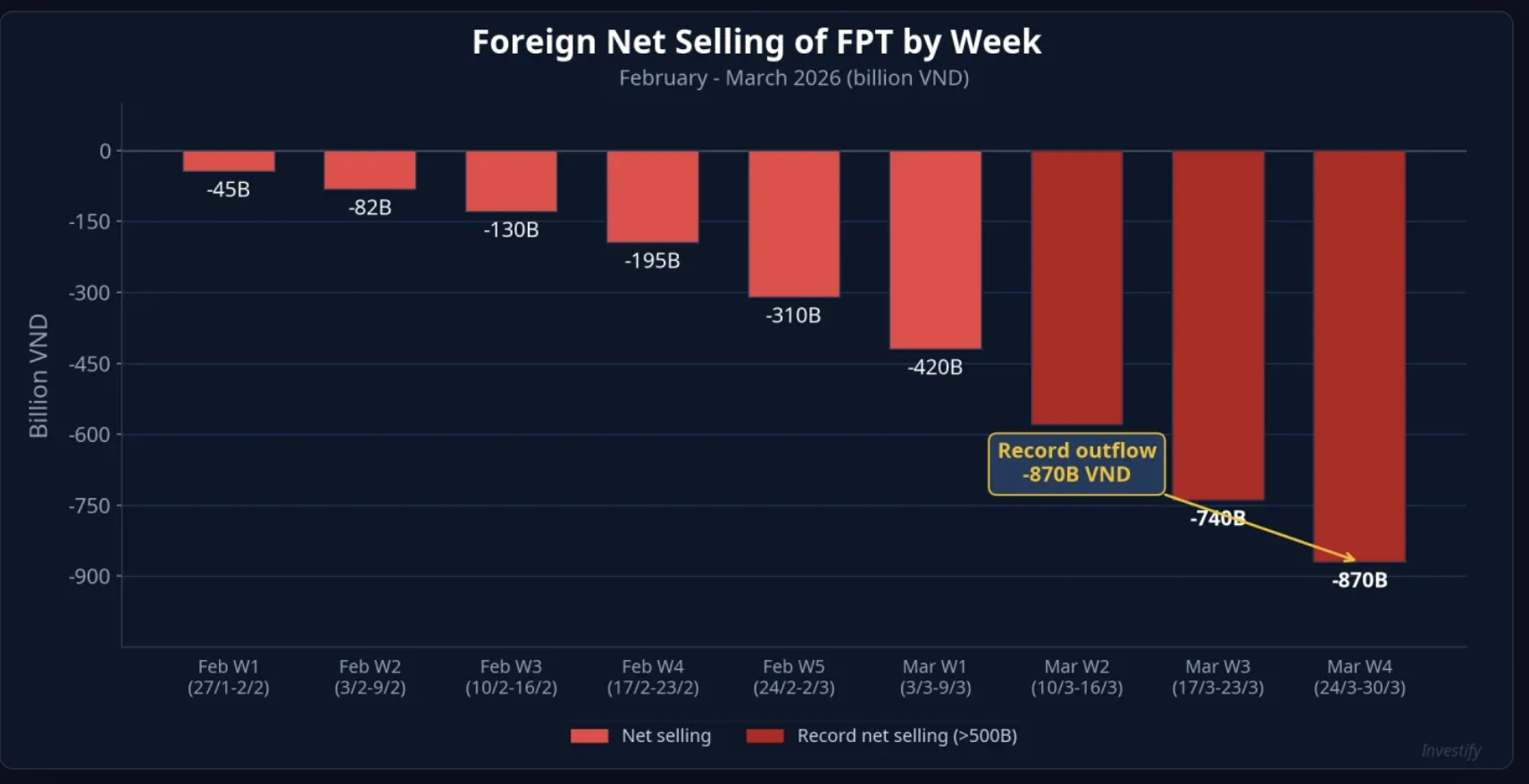
However, here is what FPT reports and statements also tell us.
Its foreign-market IT-services business grew ~ 14% in 2025. Its average production workforce grew 12% to almost 30,000 people. Revenue per employee increased 7.6%. We don’t know how they internally account for this and they surely have to show good stuff to the market. But they also emphasize a point: FPT leadership calls AI a “structural reset.”
FPT wants to turn its engineering workforce into AI-augmented engineers. According to the company reports, the ambition is to move from “Time & Materials” (e.g. traditional outsourcing) toward managed services and end-to-end solutions. It is building its own fleet of AI products and wants AI-first work to eventually account for roughly one-third of revenue.
CMC is responding from another direction.
In May 2026, it reorganized its Technology and Solutions business, consolidated consulting capabilities and made AI transformation the central axis of its 2026–30 strategy. The stated model is end-to-end as well: identify the business problem, define the roadmap, implement the technology and measure performance.
Sounds like India to me, and for good reasons.
Putting these big players aside, what else does the local labor market already tells us?
What Vietnamese hiring trends tell us
I have been in the tech sector in Vietnam for over a decade now, and my continuous conversations in the industry currently tells me that:
- QA / Testers are being laid off or experience increasing pressure
- Fresh IT graduates struggle to find jobs, which now require AI engineering skills they have to learn by themselves
- Outsourcing companies are still in the process of reshuffling their org, with mounting anxiety among staff
- Customer demand for ai solutions beyond chatbot and POCs has yet to materialize
- Outsourcing company owners are questioning their own business model and trying to find the best way to pivot
These are insights from anecdotal conversations in the industry. For what it’s worth, here is what IT Viec says about SWE hiring trends.
- Overall IT postings fell 9.3% in Q1 2026)
- But AI/Data/ML positions were up 96.6% from a year earlier.
- By Q2, overall IT postings were growing again, up 4.4% from Q1.
Earlier data showed the same split. In Q3 2025, AI/Data/ML jobs were up 42.1% year-on-year while non-AI IT jobs were down 3.1%. QA/QC postings were down 9.2% quarter-on-quarter.
There is also evidence that companies are becoming less willing to add junior and middle-level headcount. An IT Viec survey found a 7% decline in junior and middle hiring demand in the second half of 2025, with 25% of surveyed companies saying AI-driven productivity was one reason for freezing hiring or reducing headcount.
Is it all due to AI? Probably not, as Vietnam is also bracing for economic challenges.
But it does look remarkably similar to what is appearing in much better US data. In fact, Stanford / ADP has done a pretty thorough, statistical research on the impact of AI on US jobs.
Here’s what it says.
What US payroll data tells us
ADP (a huge US payroll company) has the interesting proprietary around labor that is probably more relevant than government statistics: role, tenure, payroll, and overall labor trends. Stanford and ADP partnered to produce an quite rigorous study and here’s what they found.
As of June 2026, Stanford found no widespread economy-wide employment displacement associated with AI.
But among workers aged 22–25 in highly AI-exposed occupations (eg including software engineers), employment was around 19% below where it would have been had it followed employment in less-exposed jobs (eg say plumber or electrician).
Software developers are one of the clearest cases.
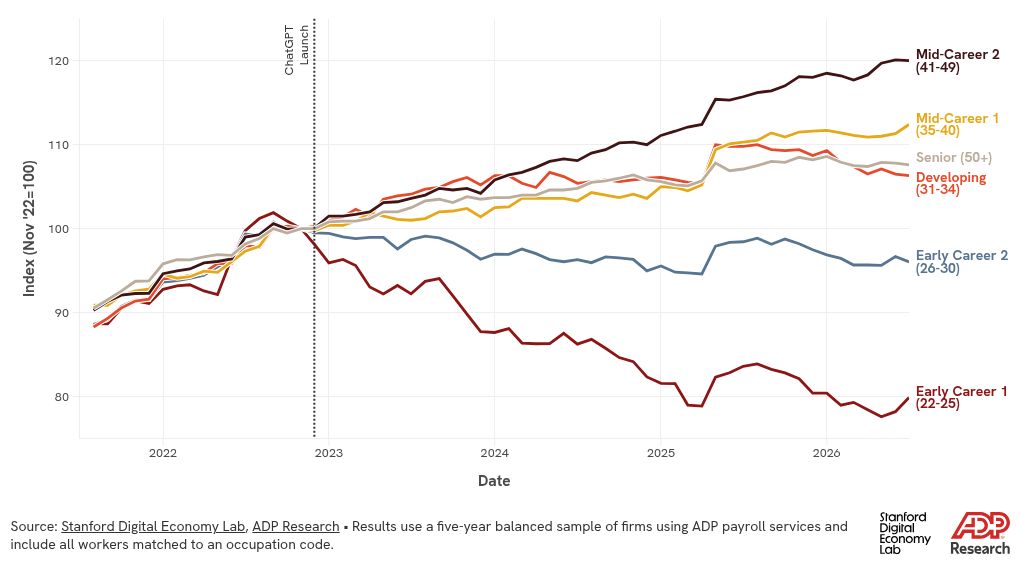
Stanford’s software-developer data shows large declines among early-career workers, modest declines in the next-youngest groups, and increase in older groups.
In a nutshell: less hiring of junior engineers, more hiring of senior ones. For the mid-level ones, there’s also a slight and steady increase in hiring.
Stanford explains it as follows. Employment is weaker for younger workers doing work dominated by knowledge that can be documented and taught (eg work now done by AI). Experienced workers whose value depends more on tacit knowledge and experience acquired through practice have a better chance (eg AI cannot entirely replicate their output yet).
That aligns with Sequoia’s piece on “the next trillion dollar company”. AI excels at reasoning, humans excel at judgment. Unfortunately for young graduates, it takes years of experience to acquire good judgment.
Then, what does the “engineer of the future” look like in a post-AI era? And is there even a future for young junior ones?
The post-AI SWE
Huyen Chip has popularized the term “AI Engineer.” Lots of things have changed since the publication of her work, and “AI engineering” is splitting into various forms as we speak.
Some AI Engineers build infrastructure. Some build agents. Some fine-tune models. Some are basically application engineers who use LLM APIs.
Here is what LinkedIn has to say about hiring trends in that broad category.
AI Engineer has overtaken Machine Learning Engineer as the most common AI role on its platform. More interestingly, Forward Deployed Engineer is already the third-most-common AI occupation in job postings (if we ignore the misc category “other AI occupations”).
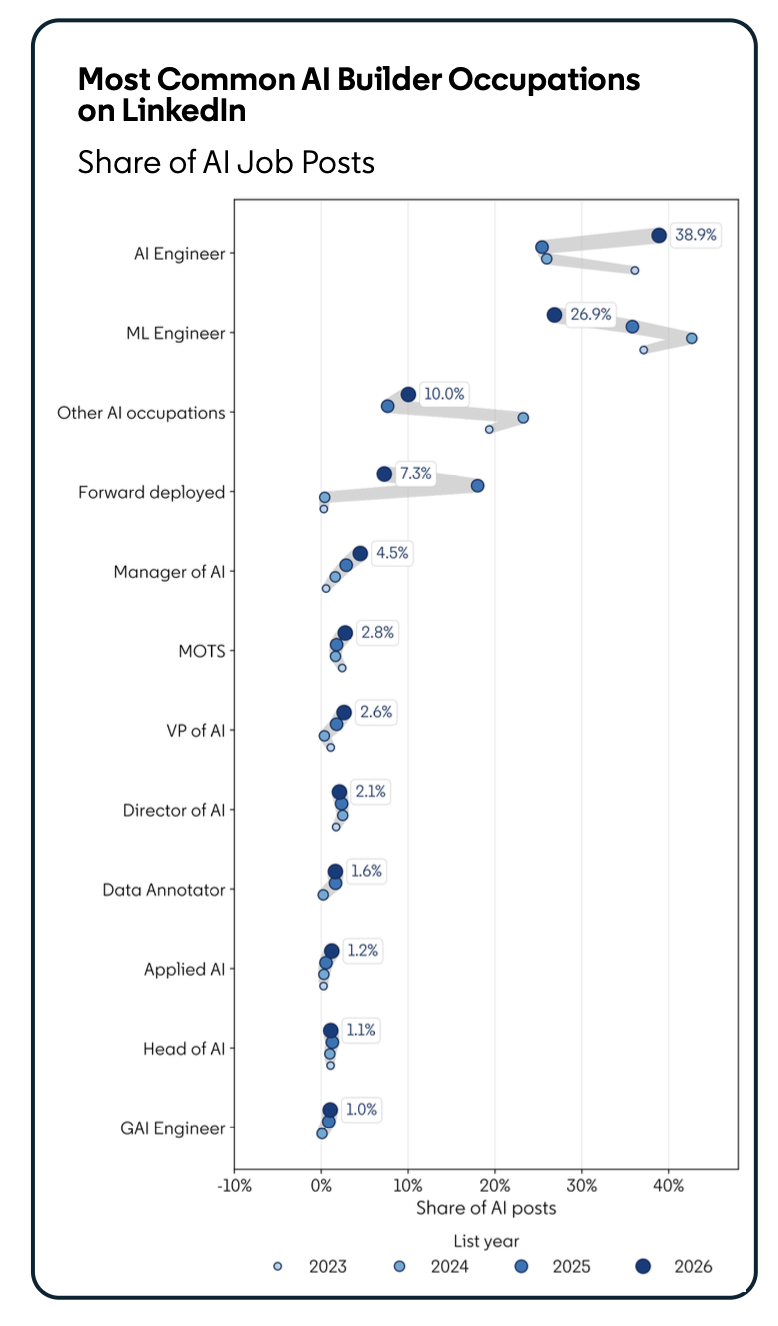
And here’s what an FDE does. S/he collapses the SDLC into one neat loop and answers the following questions by herself.
- What problem are we solving?
- What should the model do?
- What should the model not do?
- What context and data does it need?
- Which parts should remain deterministic software?
- What tools should the agents have?
- How do we know whether the output is actually good?
- How does this fit into the client’s existing systems?
- How do we help the clients monitoring agentic work?
- Can we deploy it securely?
- How do we evaluate AI outputs against the clients’ goals?
- How do we make sure end users will use it?
- What’s the next iteration of the product?
- Repeat.
Under that view, the vast majority of the actual code-writing is delegated to competent AI harnesses. SWEs spend most of the time on domain-specific problem solving, talking to end users, AI architecture design, managing agents, etc.
In other words, coding ability used to be scarce but has now become a commodity. The scarce capability is the combination of the above.
I am not saying that every VN SWE must become an FDE. FDE is probably at the extreme end of the spectrum and one should not expect every VN SWE to sit next to the customer and speak their language. But it is a useful direction in terms of “what the destination looks like”.
In a sense, FDE is the new full-stack engineer.
There are other possible directions too. One that intrigues me the most is the 1-man-army direction.
Will the 1-man-army rise?
Forget about working at a company for a moment. In fact, probably one third of Vietnamese engineers that I know have tinkered (or think about tinkering) with the idea of starting something of their own.
Let’s flip the entrepreneurial approach on its head and ask: now that AI can give “1,000 geniuses in your pocket”, could you build a company without VC-backing and make 1 $M a year instead of the VC-threshold of 100 $M / year?
Or let’s say 100 $K, not even 1 $M.
Making 100 K$ / year doesn’t sound fancy. But I think it may be more practical than “starting up”. And if one can pull that off with no employees, that’s not a bad proposition.
Here are some extreme outliers for inspiration, who all started post-GPT. To be taken with a grain of salt.
- AudioPen by Louis Pereira (more here and here)
- Started in 2023.
- Background: solo builder/product tinkerer; had tried multiple projects before without a major commercial success. He did already have roughly 10,000 X followers, so he was not starting from nothing.
- Sells: an AI voice-to-writing tool that turns rambling speech into structured text.
- Numbers: around $15k/month revenue in 2024, later reported closer to $20k/month, with no employees.
- Caveat: founder-reported revenue; prior audience helped launch distribution.
- AIDesigner.ai by Tyler Yin (more here)
- Started in 2025.
- Background: designer/developer and former product professional; no clear evidence of a previous major startup exit or successful company.
- Sells: an AI product for generating and improving UI designs/code inside modern coding workflows.
- Numbers: roughly $9k MRR and $60k+ cumulative revenue by August 2026, operated by one founder with no employees.
- Caveat: still a young business, so durability and true net profit are unknown.
- 3AK Track by Christian Rac and Braylin Byrd
- Started around early 2026.
- Background: two college track athletes with no traditional coding background and previous unsuccessful small business experiments.
- Sells: a subscription app for track-and-field athletes, built largely with AI/no-code tools.
- Numbers: roughly $11k MRR, about 3,200 active subscriptions, run by the two founders and no other outside help at the time reported.
- Caveat: they already had around 150,000 combined social-media followers, so distribution was a major pre-existing asset.
- Wrestle AI by George Lampropoulos (more here)
- Started in 2025.
- Background: teenager with no conventional software-development skills and no prior significant entrepreneurial success.
- Sells: AI-powered mobile apps for wrestling/fight-related users, built largely through AI app-building tools.
- Numbers: reported $131k+ revenue over six months, with Wrestle AI reaching roughly $23k MRR and combined apps reportedly peaking near $39k/month.
- Caveat: revenue figures are largely reported by the AI development platform used to build the apps; he also had a creator/commercial partner, so this is not a pure one-person business..
Surely, this is anecdotal evidence and loosely audited. It only proves that it is possible, and suggests that the minimum organization required to generate some form of profit appears to be just you and AI.
But notice how they “made it”:
- They had distribution - a form of audience to monetize
- Or some domain expertise - eg Christian & Braylin, Tyler
- And understood how to sell
There’s probably more variations of success, and 1-man-army may become 3-(wo)men-army. But the idea is the same: own your independence and make enough for the lifestyle you want, by leveraging AI.
And no matter the choice - to work for someone else or for oneself - a similar mindset and skillset is required. It reads something like this:
I think that building such a skillset is a pretty safe bet for the foreseeable future.
A darker view of the future
As the Stanford study starts to show, companies hire less junior people, favoring the more experienced ones. Since every company has an economic incentive in doing so, everyone does it, until the hard question of “where is the succession bench?” comes up.
Which brings us to the following scenario: a generation of young computer science graduates gets partially hollowed out by AI.
But what’s the probability of that happening?
Of course, no one knows the exact number. The future cone of possibility gives us a useful heuristic to put some rough probabilities on events. They range from preposterous (say, less than 5-10% of happening) to possible, plausible and probable, with increasing probability (say, > 75% change for ‘probable’).
Where would the “AI leads to a hollowing out of junior engineers” scenario fall?
Which is akin to saying: “Unless companies have a new economic incentive to keep hiring juniors (or are forced to, by state intervention or similar), then hiring less juniors is an outcome to expect, which leads to a hollowing out of that group over time”.
A quite sobering thought.
Bringing it altogether
Based on all of the above, we can reasonably predict that the following things will happen in Vietnam, probably over the next 12-18 months:
- Lower employment opportunities for junior SWE.
- A period of lower demand from international clients for traditional outsourcing services, that may be offset by new demand for AI solutions, but creating profitability pressure in the meantime for small firms.
- Hiring demand for FDE-like engineers increases progressively, but not strong enough to absorb the number of SWE looking for jobs, depressing salaries overall.
- Mindset and skillset across the software engineering profession change to adapt to the new reality.
- Likewise, new economic and delivery models in the outsourcing industry appear to “follow the money”.
In other words, brace for impact. Looks like the road ahead is going to be very bumpy.
But as the saying goes, every challenge is an opportunity in disguise. We just don’t know what clothes they wear just quite yet.
Further reading
- Survey on Computer Software and Information Technology Enabled Services Exports: 2023-24
- Zinnov-Nasscom India GCC Landscape Report 2026
- IT services for foreign markets
- Vietnam IT Recruitment Market Overview in Q3-2025
- Canaries in the Coal Mine? Six Facts about the Recent Employment Effects of Artificial Intelligence
- New LinkedIn Research On The AI Divid In 2026